DETERMINE RING SIZE
Here are some things to consider when determining your ring size:
- Weather conditions - When it is cold, our fingers become thinner and the ring will feel looser. When it's warm, they often expand. If you are in a humid environment, or want to wear your rings all the time without taking them off, you should definitely take this into account as well.
- Change in the thickness of your fingers - A finger can vary considerably in thickness at different times of the day. Fingers are thicker in the morning than in the evening. Changes in environment, eating habits, illness, salt intake, medication and not to mention pregnancy can also affect your finger thickness.
- Standard ring sizes - Different countries and brands often work with different ring sizes, so there is no real standard. We stick to the Dutch sizes using the diameter in millimetres.
Here are some more tips to measure your ring size yourself:
METHOD 1: RING DIAMETER USING RULER
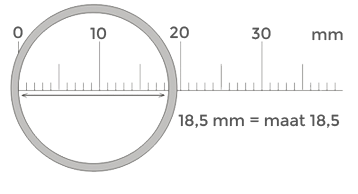
- Place a ring that fits you well on a ruler.
See how many mm the ruler on the inside of your ring indicates. (So don't count the thickness of ring).
If you do not arrive at an exact size, always round up the number.
For example, if this is 18.5 mm then your ring size is 18.5.
METHOD 2: FINGER CIRCUMFERENCE
- Find a piece of string or paper no more than ½ cm wide.
- Wrap the string or piece of paper around the widest part of your finger, otherwise the ring will not fit over your knuckles.
- Use a pen to mark on the string/paper where the point of overlap is, if the string/paper forms a complete circle.
- Using a ruler, measure the length from the starting point to the point marked with the pen on the string/paper.
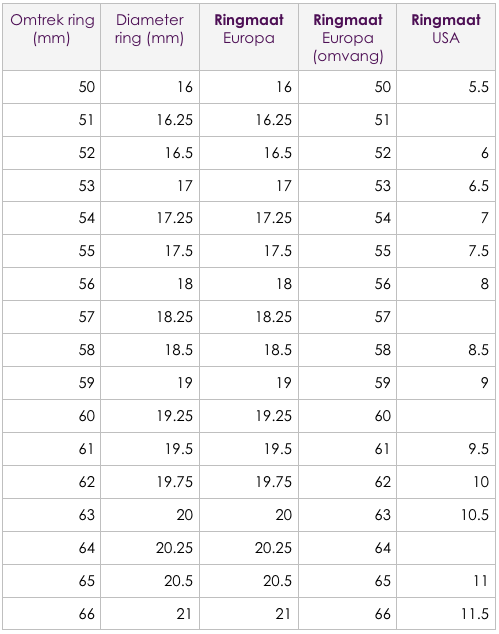
- In the table below you can find the ring size.
|